We all read labels these days. We check for calories, carbs, and hidden nasties, trying to make better choices for our bodies. But how often do we stop to think about the planet’s health when we pick up a bag of sweetener?
The debate usually stops at “sugar vs. natural alternatives” for our health, but there is a massive environmental story here that often gets missed. It turns out, the journey from farm to spoon is very different for jaggery than it is for white sugar. While industrial sugar manufacturing is a resource-heavy beast, sustainable jaggery production is a lesson in how food processing should be done.
If you’re trying to lead an eco-conscious lifestyle, making the switch to jaggery isn’t just a treat for your taste buds–it’s a genuine vote for a greener earth.
The Hidden Cost of Sweetness
To really understand why jaggery is better than sugar ecologically, we have to look at the whole lifecycle.
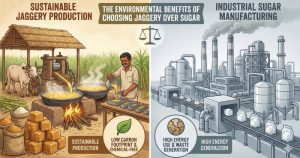
Refined white sugar is the product of massive industrial mills. These facilities are energy-hungry giants that guzzle water to power crushers, boilers, and centrifuges. And that pristine white color? That usually comes from a bleaching process involving sulfur dioxide and phosphoric acid–chemicals that end up as by-products which, if not managed strictly, can wreak havoc on local water bodies.
On the flip side, jaggery (or Gur) is the complete opposite. It’s typically produced in small, decentralized units called “Kolhus.” The philosophy here is simple: minimal waste, minimal fuss. By skipping the intense crystallization and chemical bleaching phases, jaggery retains its natural minerals and requires significantly less energy and water to produce.
Farm to Table: A Tale of Two Processes
The biggest difference lies in the nitty-gritty of how they are made. Let’s break down the environmental impact of the production lines.
1. The Fuel Source
In big sugar factories, the boilers are often fired by coal or natural gas to generate the massive steam needed for processing. This pumps greenhouse gases directly into the atmosphere.
Sustainable jaggery production, however, is often a closed loop. The fibrous residue left after crushing the sugarcane–known as bagasse–is sun-dried and fed right back into the furnace to boil the juice. They are literally using the waste from the cane to process the cane. It’s a brilliant example of a circular economy that eliminates the need for external fossil fuels.
2. Ditching the Chemicals
Making sugar white is a chemical engineering feat. To strip away the natural brown color, the juice is treated with lime, sulfur dioxide, and sometimes bone char.
Jaggery doesn’t need a chemistry lab. Traditional makers use natural clarifiers, like the mucilage from the wild okra plant (Sukhlai) or simple baking soda, to skim impurities off the boiling juice. This means the waste slurry is organic and biodegradable–you could dump it in a field and the soil would thank you, unlike the sulfur-laden sludge from sugar mills.
4 Reasons Jaggery is the Eco-Friendly Champion
When you strip it down, there are four clear reasons why jaggery stands out among natural sugar alternatives.
- A Smaller Carbon Footprint: Because jaggery is made in small batches locally, it bypasses the heavy machinery and long-haul transport networks of centralized factories. Using renewable bagasse for fuel instead of coal makes the carbon footprint per kilogram tiny in comparison.
- Saving Our Water: Industrial sugar mills are notorious for releasing effluents that deplete oxygen in rivers, killing aquatic life. Jaggery units produce almost zero liquid waste. The “scum” removed during boiling is organic and often goes right back to the fields as fertilizer.
- Supporting Sustainable Farming: Jaggery and sustainable farming go hand in hand. Jaggery production is usually a cottage industry run by farmers themselves. This keeps economic power in local hands and encourages diverse agricultural practices, rather than the industrial monocultures required by big sugar companies.
- The Zero-Waste Philosophy: The jaggery process wastes nothing. The juice becomes sweetener, the fiber fuels the fire, and the ash left behind is rich in potash, so it goes back into the soil. It’s a perfect cycle.
Living the Eco-Conscious Life
Living sustainably is usually about making small, consistent swaps that add up. Replacing refined sugar with eco-friendly sweeteners like jaggery is one of the easiest changes you can make.
When you buy jaggery, you are creating demand for a supply chain that respects the environment. You’re saying “no” to coal-fired plants and chemical bleaching agents. Plus, let’s be honest–jaggery just tastes better. That rich, caramel-like flavor adds a depth to coffee and baking that white sugar just can’t match.
The Verdict
When you look at the jaggery vs sugar environmental impact, the winner is clear. White sugar offers convenience and visual uniformity, but it comes at a steep price paid by our rivers, soil, and air.
The environmental benefits of jaggery–from its low carbon footprint to its chemical-free roots–make it the superior choice for the planet. So, the next time you need to sweeten your tea, reach for the jaggery. It’s a small switch, but it makes a world of difference.
Also Read: How Is Bamel Gruh Udyog Empowering Rural Communities?